








-

LANGUAGE/言語
-

INITIATIVES TOWARD SUSTAINABILITY
The Fun of Reading Accessible to Everyone —Creating Universally Accessible Published Content and Improving Accessibility—
- “The Reading Barrier-Free Act” was enacted. It encourages publishers to create universally accessible published content and improve accessibility to it.
- For many years, KADOKAWA has been a leader in the publication of universally accessible e-books and audiobooks.
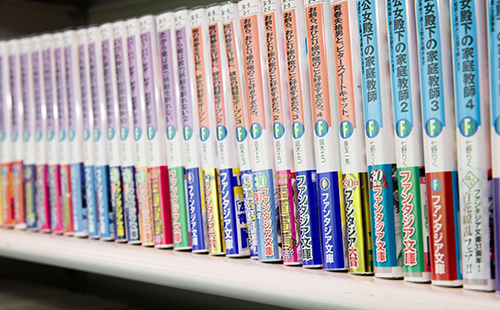
- Since 2024, the Company has taken on new challenges, including the publication of Large Print Kadokawa Tsubasa Bunko editions of books.
“The Reading Barrier-Free Act” was enacted in June 2019 to make it possible for everyone to benefit from a writing and publishing culture through reading, regardless of ability. Several years have passed since the law was enacted, but the inclusive publication of books and the improvement of accessibility have not advanced sufficiently in the area of published content such as novels, comics, and picture books.
The Ministry of Health, Labour and Welfare reported that there are over 11 million people with disabilities in Japan. Over 9% of the total population has some kind of disability (FY2022 Annual Report on Government Measures for Persons with Disabilities). Additionally, the World Blind Union has estimated that people with disabilities in developing countries are able to read less than 1% of all books published. People with disabilities in developed countries are able to read around 7% (World Blind Union's Issue Brief for Asia-Pacific published in December 2017). People who want to read books cannot. The World Blind Union called this situation a “book famine” to highlight that too few books are being published in formats that people with visual and other disabilities can read. Many people who have difficulty reading want to end the “book famine.”
One solution to the “book famine” is universally accessible books designed to be easy for people who have difficulty reading generally available books to read. Examples of these universally accessible books include e-books, where the font size can be enlarged, audiobooks that can be enjoyed by listening to the books being read out loud, braille books that can be read by touch, and easy-to-read LL books with simple sentences, furigana (phonetic Japanese characters printed above more complicated Japanese kanji characters), photos, and pictograms.
The KADOKAWA Group has proactively worked on e-books and audiobooks since the industry’s earliest days, as a comprehensive entertainment company enabling all people to experience pleasure and be inspired while eliminating barriers with the hope that more people will enjoy published content. The KADOKAWA Group will continue to improve its services and take on new challenges while pursuing ideal forms of books that are easier to see and read. Below are various initiatives the KADOKAWA Group is implementing related to universally accessible books, including e-books and audiobooks.
- 【TOPIC 1】A total of 160,000 e-books have been published. They are examples of universally accessible books
- 【TOPIC 2】The KADOKAWA Group's lineup of audiobooks that people can listen to further enhanced
- 【TOPIC 3】Large Print Kadokawa Tsubasa Bunko rolled out in March 2024
- 【TOPIC 4】Workshops held to promote employees' understanding of universal accessibility in reading
- 【TOPIC 5】Assistance provided for an exhibition of books related to the Tabletop Role-Playing Game at the conference of the Japan Academy of Learning Disabilities
【TOPIC 1】A total of 160,000 e-books have been published. They are examples of universally accessible books
E-books are one of the most familiar types of universally accessible books. Their features include being able to enlarge text and use text-to-speech (TTS) software. In addition, it is easier for people who have difficulty turning the pages of paper books to use e-books.
The KADOKAWA Group has been implementing e-book initiatives for more than 20 years.
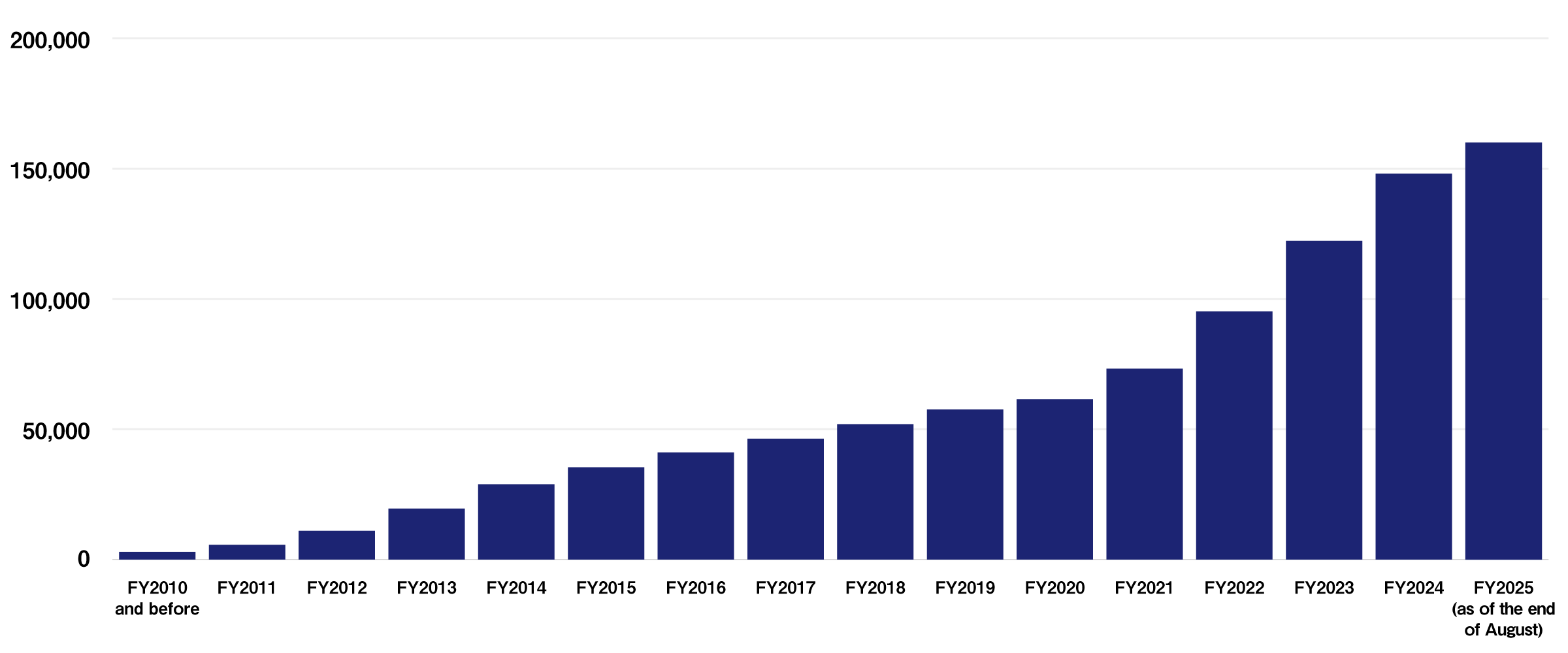
There are approximately 160,000 KADOKAWA Group e-books as of the end of August 2025. Of them, 32,000 are text to speech (TTS) e-books.
Total number of e-books
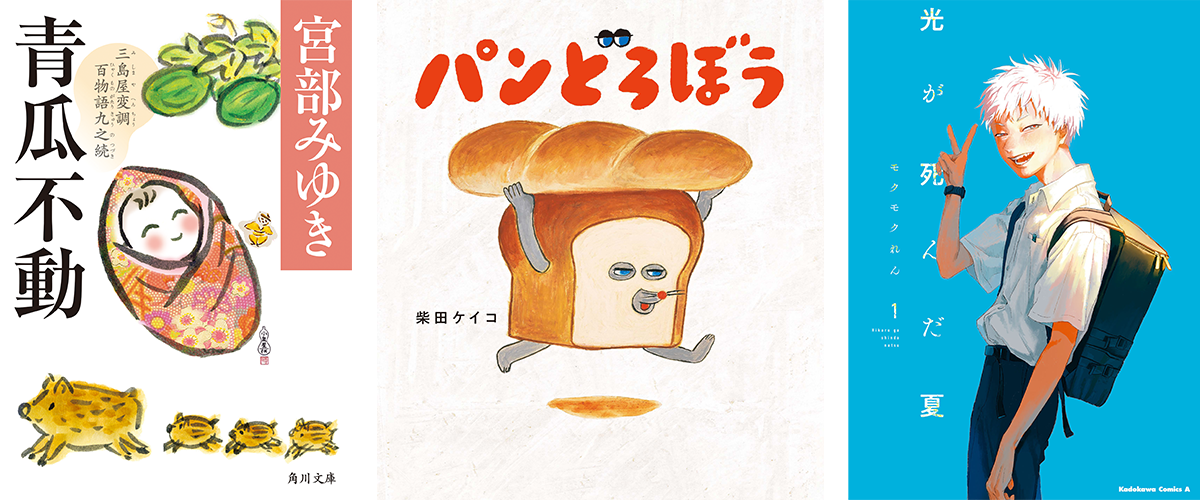
The three works below attracted particular attention.
- Four stories from Mishimaya hencho hyaku monogatari series (Miyuki Miyabe) about apparitions in the Edo Period, a long-term project the author has been engaged in
- The PANDOROBO series (Keiko Shibata) of picture books to be adapted into anime in 2026
- The Summer Hikaru Died (Mokumokuren), a comic that had a lot of buzz after the broadcast of an anime adaption from July to September 2025
The KADOKAWA Group has continuously offered new works and popular works in e-book formats.
In addition to publishing e-books, the KADOKAWA Group has worked to increase the number of e-books in libraries. One KADOKAWA Group initiative is its participation in the management of Japan Digital Library Service Co., Ltd. to contribute to the pioneering and expansion of e-books in libraries and the maintenance and development of print culture.
- What is the Reading Barrier-Free Act?
“The Act on Promoting Improved Reading Environments for the Visually Impaired, etc.,” also known as “the Reading Barrier-Free Act,” was enacted in 2019. The visually impaired are people who have difficulty understanding visual media due to disabilities. Specifically, these disabilities include visual, hearing and other physical disabilities, mental or intellectual disabilities, internal organ disabilities, developmental disabilities, and learning disability. One thing that book publishing companies can do to address issues people with visual impairments experience is to publish universally accessible books (e.g., braille books and e-books).
【TOPIC 2】The KADOKAWA Group's lineup of audiobooks that people can listen to further enhanced
Audiobooks that people listen to are universally accessible books, and it is expected that their popularity will continue to increase in the future. Audiobooks have received a lot of support from people who have difficulty reading, such as people with visual or learning disabilities.
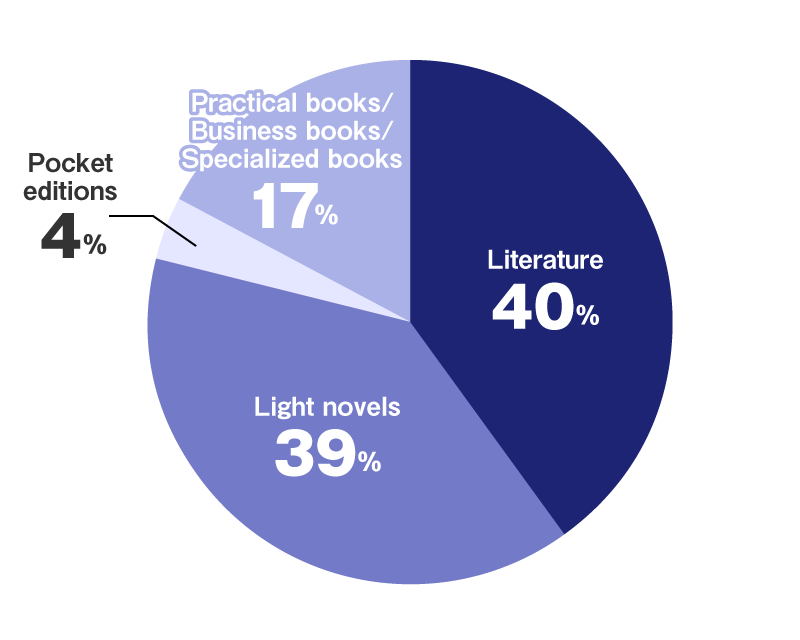
The KADOKAWA Group started implementing initiatives in around 2007, and they have already published more than 2,000 audiobooks. Audiobooks are available in a wide range of genres, including literature, light novels, pocket editions, practical books, business books and specialized books.
Breakdown of the number of KADOKAWA audiobooks by genre
*As of June 2025
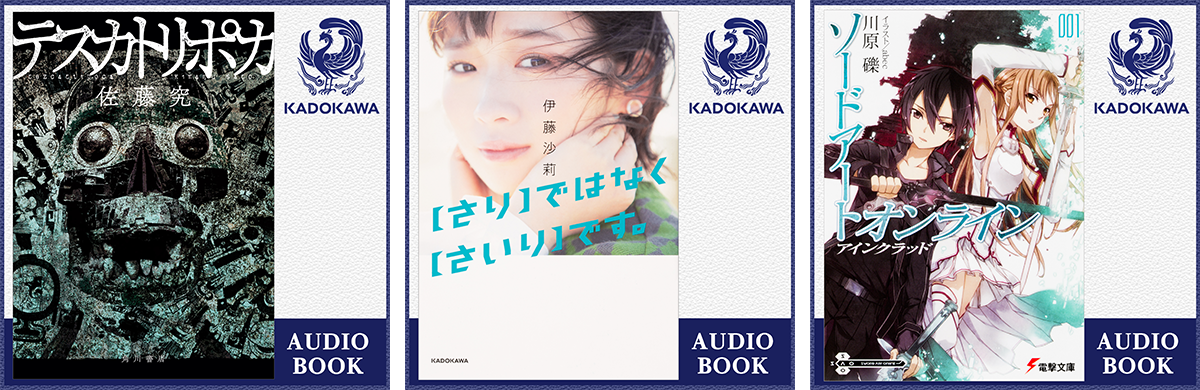
Audiobooks that have recently attracted attention include:
- Tezcatlipoca, Kiwamu Sato's masterpiece crime novel that received the Naoki Prize
- Call Me Sairi, not Sari, an essay read by the author, Sairi Ito, who is a popular actress who has starred in works such as “The Tiger and Her Wings”
- Sword Art Online, a gold-standard light novel by Reki Kawahara that has been adapted into an anime
【TOPIC 3】Large Print Kadokawa Tsubasa Bunko rolled out in March 2024
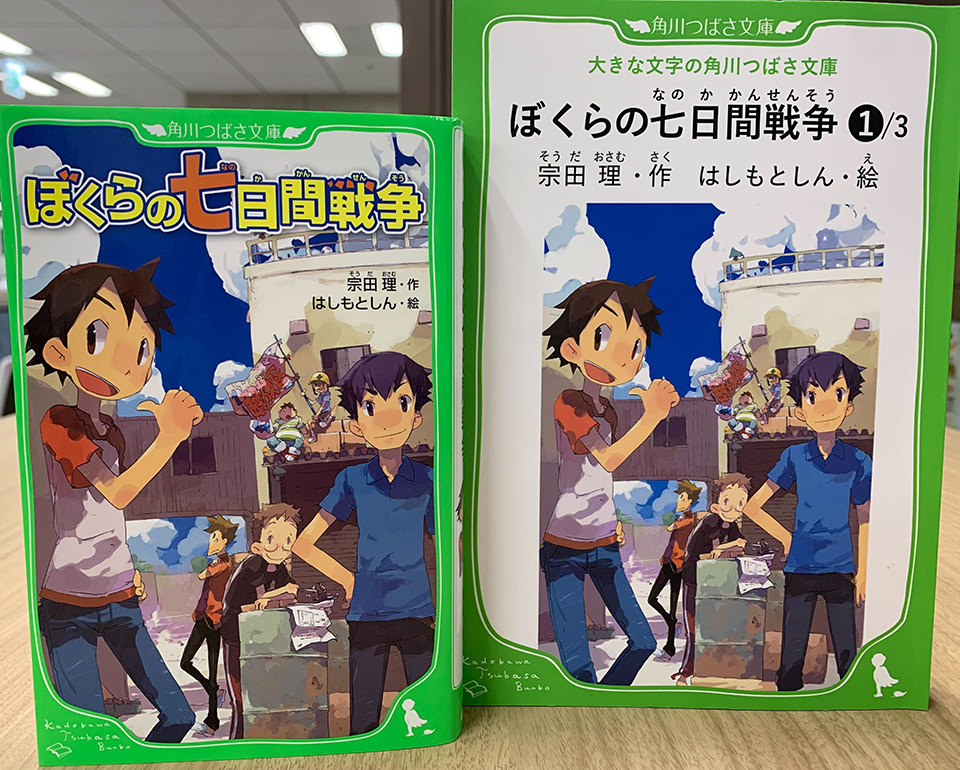
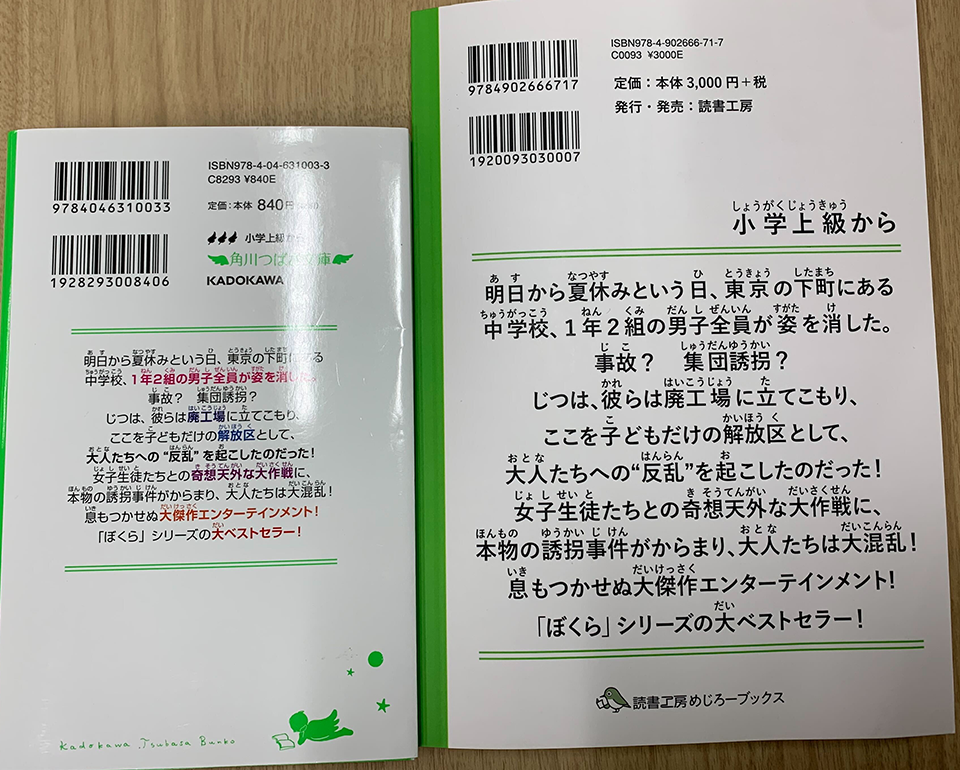
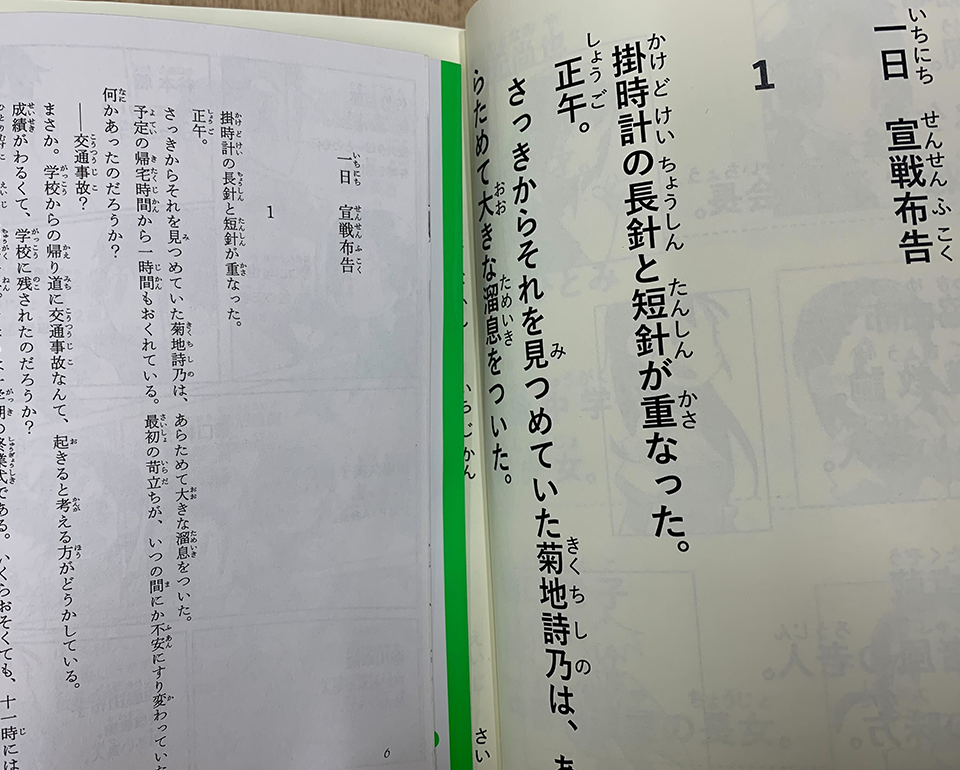
Large print books are one type of universally accessible book that is popular with people who have visual, developmental or other disabilities. This type of book is re-formatted, widening the space between lines and type to increase legibility.
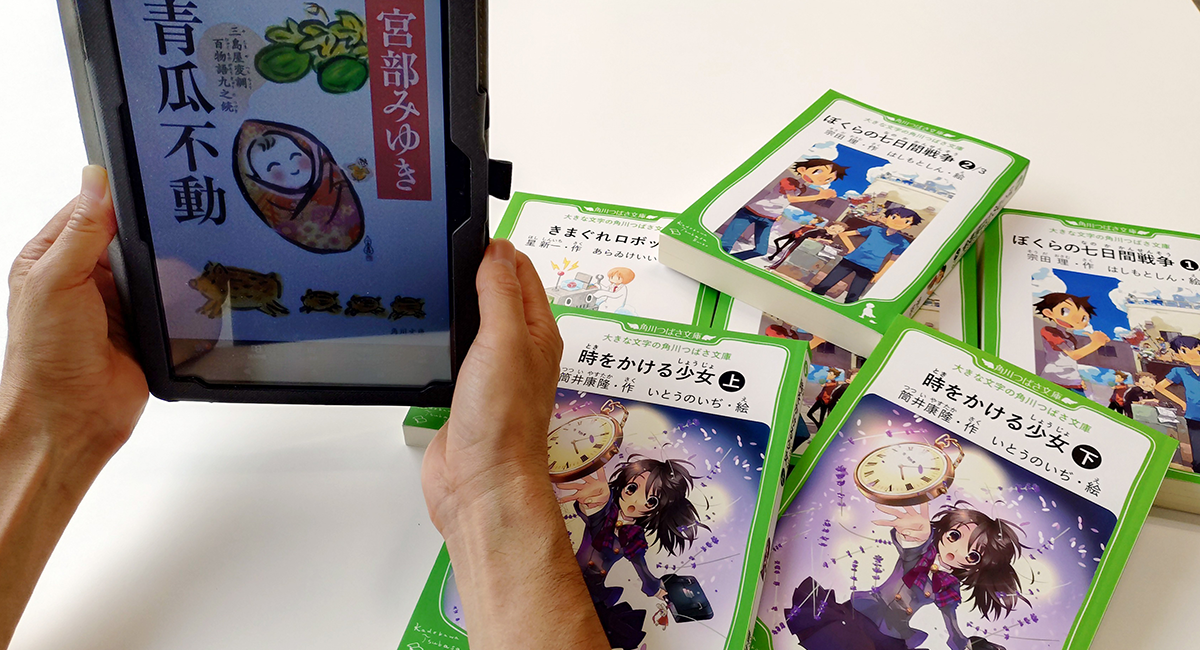
The Dokusho Kobo Mejiroh Books series of books created by Dokusho Kobo Inc. enables readers to read books with enlarged type, and the Kadokawa Tsubasa Bunko books were included in the Dokusho Kobo Mejiroh Books lineup in March 2024. Kadokawa Tsubasa Bunko has published three large print titles (six volumes) to date. The Large Type Kadokawa Tsubasa Bunko books have been well received by many people and organizations including school libraries and public libraries. They have an easy-to-read font (22 point Yu Gothic).
▼Click the following links for details.
*The link goes to the Dokusho Kobo website.
- Our Seven Days War (1), Our Seven Days War (2), Our Seven Days War (3) (Osamu Soda)
- The Whimsical Robot (Shinichi Hoshi)
- The Girl Who Leapt Through Time (Vol. 1) and The Girl Who Leapt Through Time (Vol. 2) (Yasutaka Tsutsui)
【TOPIC 4】Workshops held to promote employees' understanding of universal accessibility in reading
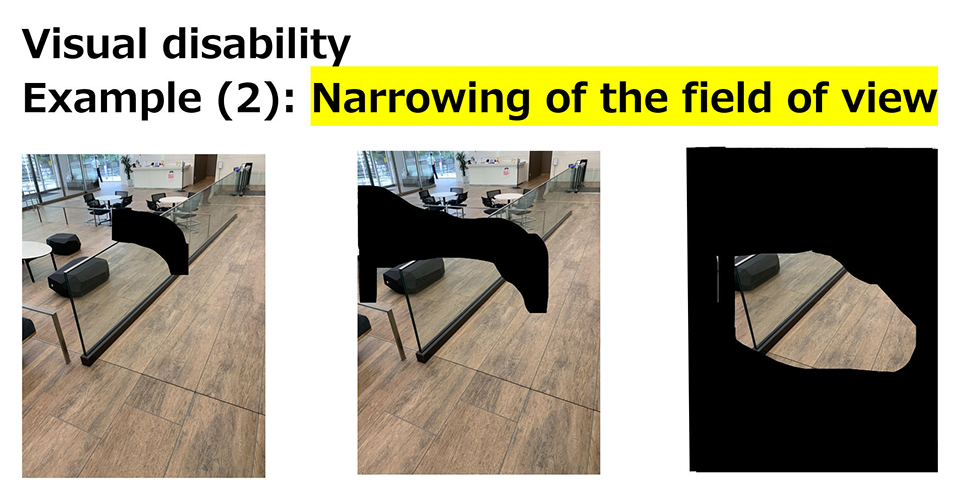
In February 2025, Group employees participated in an online workshop that Senshu University's Prof. Takenori Noguchi lectured at.
Prof. Noguchi talked about the following wide-ranging topics:
- The Reading Barrier-Free Act
- Various disabilities
- Introduction of universally accessible books (e.g., braille books, e-books, audiobooks, large print books, LL books)
- Explanation on universal fonts and color universal design
- What publishers can do
The workshop enabled us to promote the KADOKAWA Group employees' understanding of the inclusive reading of published content and universal accessibility to it. We will plan workshops and other opportunities for the Group employees to promote people's understanding of inclusive reading.
- ■ Prof. Takenori Noguchi
Professor at Senshu University's School of Letters. He is a member of the Ministry of Education, Culture, Sports, Science and Technology's panel of experts on the enhancement of operation of libraries and school libraries and the same ministry's council on the improvement of the reading environment for people with visual disabilities and others. His research themes include children's reading, services for people with disabilities and e-book services.
【TOPIC 5】Assistance provided for an exhibition of books related to the Tabletop Role-Playing Game at the conference of the Japan Academy of Learning Disabilities
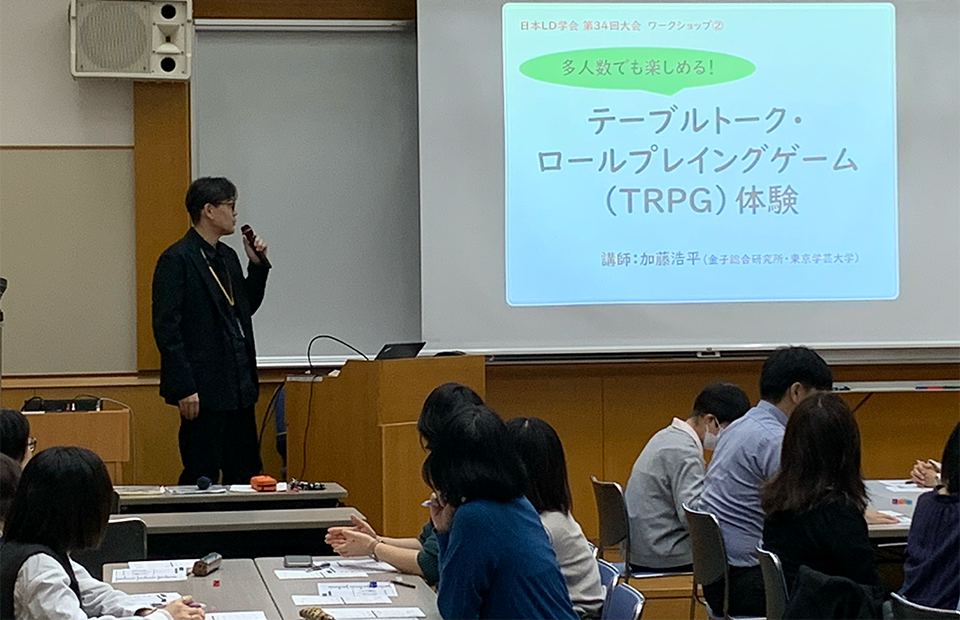
The 34th conference of the Japan Academy of Learning Disabilities was held at National Olympics Memorial Youth Center on October 18 and 19, 2025. The Japan Academy of Learning Disabilities is a research organization focused on developmental disabilities, such as learning disabilities (LDs), attention-deficit hyperactivity disorder (ADHD), and autism spectrum disorder (ASD).
At the conference, the Tabletop Role-Playing Games (TRPGs) ― Worlds of Enjoyable Communication for Weaving Tales Through Conversation workshop was held. The workshop was led by Dr. Kohei Kato, the director of the Kaneko Research Institute and a researcher and part-time lecturer at Tokyo Gakugei University. He uses the conversation-based TRPG, in which a facilitator and players work together to tell a story, to support the communication and leisure activities of children with developmental disabilities. Playing a character in the TRPG helps people with developmental disabilities improve their ability to communicate with others. Playing a character in a TRPG helps people with developmental disabilities improve their ability to communicate with others. It is expected that TRPGs will help people develop their social and communication skills.
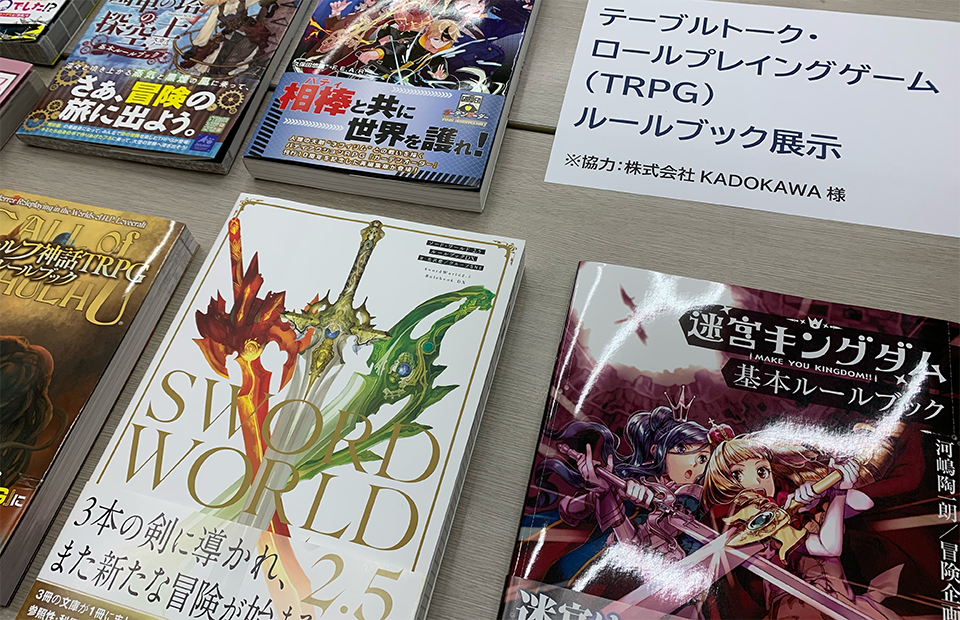
KADOKAWA has published many TRPG-related titles, and it supported the above two-day workshop that was attended by about 90 teachers, researchers, and guardians of children with disabilities. TRPG rule books were displayed at the workshop, including Sword World 2.5 Rule Book DX (Kei Kitazawa/Group SNE), Arianrhod RPG 2E Revised Edition Rule Book 1 (Takeshi Kikuchi/F. E. A. R.), Labyrinth Kingdom Basic Rule Book (Toichiro Kawashima/Adventure Planning Service). We will continue to seek opportunities to cooperate in these efforts using content published by the KADOKAWA Group.
- ■ Dr. Kohei Kato
Director of Kaneko Research Institute and researcher and part-time lecturer at Tokyo Gakugei University. Presides over “SUNDAY PROJECT,” a leisure activity for children with developmental disabilities that involves playing tabletop role-playing games (TRPGs).
Click the link below for more information about the Japan Academy of Learning Disabilities.
Japan Academy of Learning Disabilities
Editing collaborator:
KADOKAWA “Project Supporting People with Disabilities and Their Families and Facilitating Inclusion” (One of the “Project Open Call” initiatives in which employees of the KADOKAWA Group propose challenging medium- and long-term cross-departmental projects and work to realize them as a project steering team with members recruited from within the Group. These initiatives are now being implemented with the goal of ensuring that KADOKAWA continues to be a company where everyone is needed and can work with job satisfaction and the ability to dream, regardless of ability.)
Target SDGs
![[Goal 3]Good Health and Well-Being/[Goal 4]Quality Education/[Goal 10]Reduced Inequalities](/themes/group.kadokawa/assets/images/img_sustainability_reading-accessibility_sdgs_en.png)
Published in December 2025